
Master APA 7 referencing
Find formats and examples for books, articles, websites, artificial intelligence and images.
Last updated 8 April 2026
What Is APA 7?
APA (American Psychological Association) citation style is widely used in academic writing, specifying rules for formatting papers, citations and references. The 7th edition was released in October 2019.
The two parts of citation
One part appears in your paragraph. The other appears in your reference list. Both are needed for a complete citation.
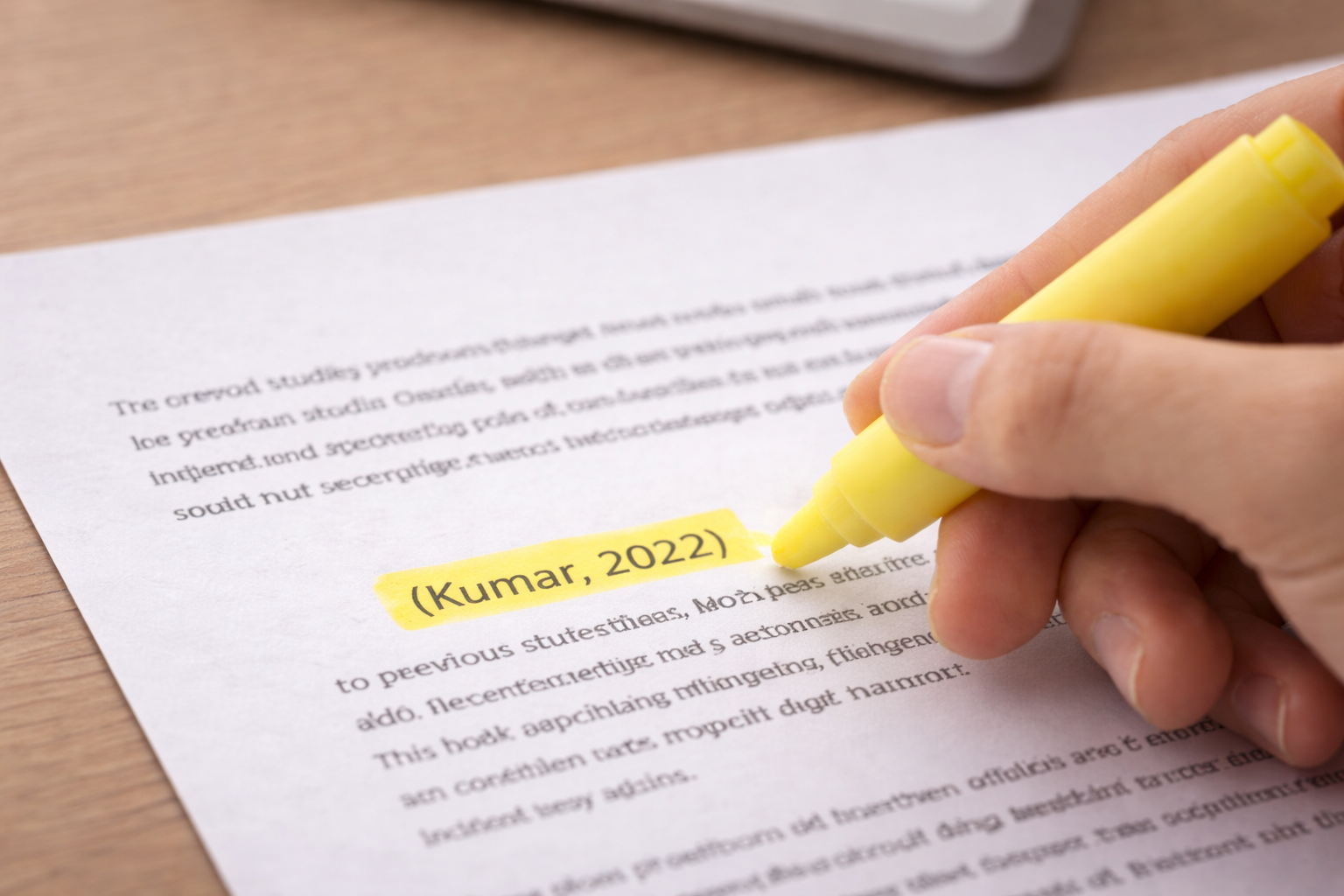
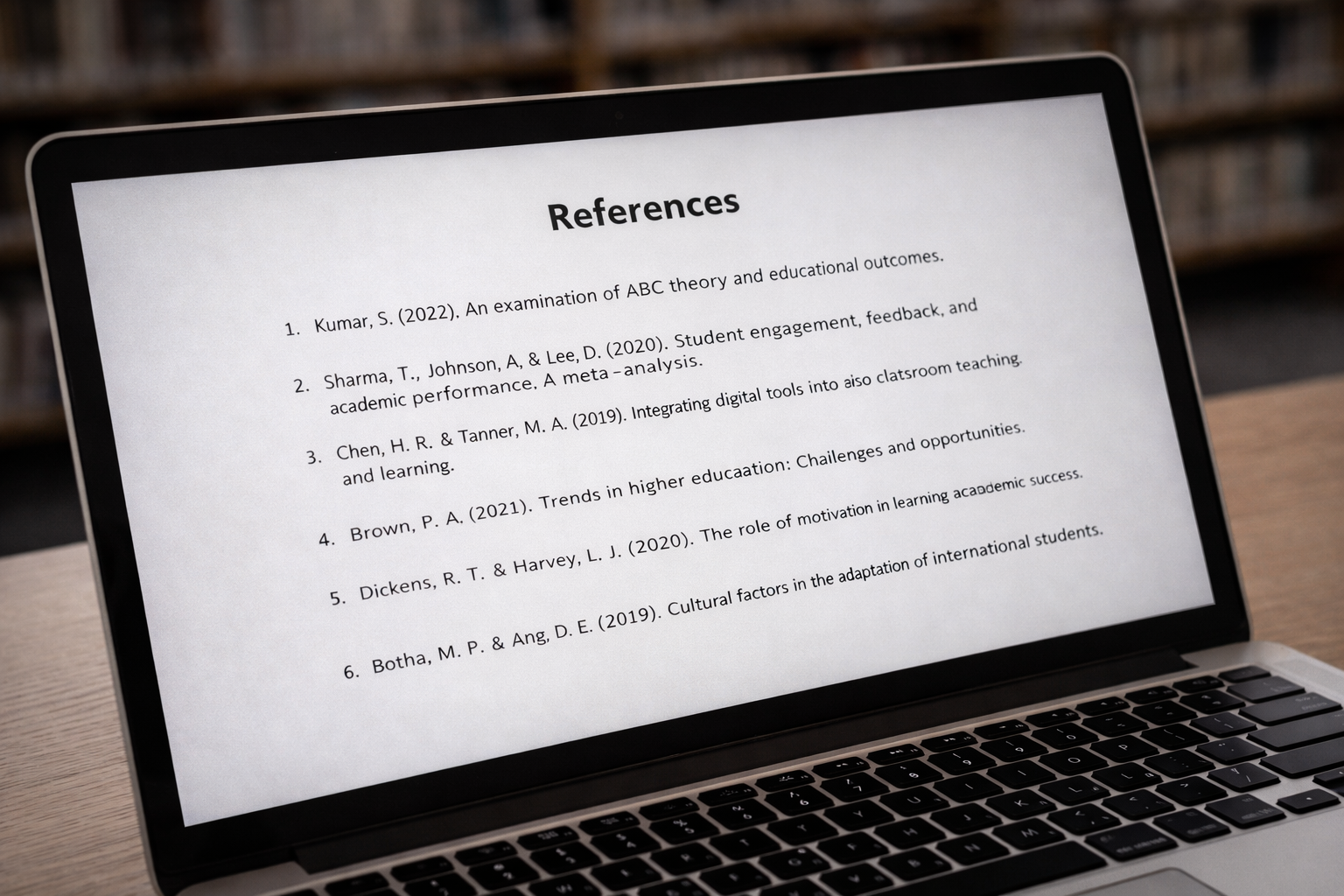
In-text citations from APA
For works of one or two authors
For a work with one or two authors, include the author name(s) in every citation.
One author
Parenthetical citation:
(Luna, 2020)Narrative citation:
Luna (2020)
Two authors
Parenthetical citation:
(Salas & D’Agostino, 2020)Narrative citation:
Salas and D’Agostino (2020)
Reference:
Publication Manual of the American Psychological Association (7th ed.), p. 266
For works with three or more authors
For a work with three or more authors, include only the first author plus “et al.” in every citation.
Three or more authors
Parenthetical citation:
(Martin et al., 2020)Narrative citation:
Martin et al. (2020)
Note: This is different from APA 6th edition.
More information:
https://nyp-sg.libguides.com/c.php?g=926326&p=6690789
Reference:
Publication Manual of the American Psychological Association (7th ed.), p. 266
For works by group authors
i) Group author with abbreviation
Parenthetical citation
First citation:
(National Institute of Mental Health [NIMH], 2020)Subsequent citations:
(NIMH, 2020)
Narrative citation
First citation:
National Institute of Mental Health (NIMH, 2020)Subsequent citations:
NIMH (2020)
ii) Group author without abbreviation
Parenthetical citation:
(Stanford University, 2020)Narrative citation:
Stanford University (2020)
Reference list from APA: Books
Books
Includes authored books and edited books
For ebooks, the format, platform, and device (such as Kindle) are not included
For a chapter in an authored book, provide the reference for the whole book and include the chapter in the in-text citation only
Template for books
Author or Editor | Date | Title | Publisher | DOI or URL |
|---|---|---|---|---|
Author, A. A., & Author, B. B. | (Year). | Title of book. Title of book (6th ed., Vol. 2). | Publisher Name. | https://doi.org/xxxxx https://xxxxx |
Name of Group. | (Year). | Title of book. Title of book (6th ed., Vol. 2). | Publisher Name. | https://doi.org/xxxxx https://xxxxx |
Editor, E. E. (Ed.). | (Year). | Title of book. Title of book (6th ed., Vol. 2). | Publisher Name. | https://doi.org/xxxxx https://xxxxx |
Book with a DOI
Whittaker, J. (2019). Tech giants, artificial intelligence, and the future of journalism. Routledge. https://doi.org/10.4324/9781351013758
Book without a DOI (from most academic research databases or print version)
Karaoulani, A. (2020). Small business management: A road map for survival during crisis. Business Expert Press.
Edited book without a DOI (from most academic research databases or print version)
Koh, T. (Ed.). (2020). Fifty secrets of Singapore’s success. Straits Times Press.
Ebook without a DOI, with a nondatabase URL
Punt, M. (2020). [Review of MEDICAL TECHNICS, by D. Idhe]. Leonardo, 53(5), 581–582. https://www.jstor.org/stable/26952038
Authored book with editor credited on book cover
Meadows, D. H. (2008). Thinking in systems: A primer (D. Wright, Ed.). Chelsea Green Publishing.
Chapter in an edited book with a DOI
Includes entries in reference works (e.g. dictionary, thesaurus, encyclopedia)
Template for edited book chapters
Chapter Author | Date | Chapter Title | Edited book information | DOI or URL |
|---|---|---|---|---|
Author, A. A., & Author, B. B. | (Year). | Title of chapter. | In E. E. Editor (Ed.), Title of book (pp. 10–23). Publisher Name. | https://doi.org/xxxxx |
Chapter in an edited book without a DOI
(from most academic research databases or print version)
Colgan, S. T., Mazzeo, T., & Orr, R. (2018). Regulatory expectations and industry practice on stability testing.
In F. Qiu & G. Scrivens (Eds.), Accelerated predictive stability (pp. 15–32). Academic Press.
Authored vs. Edited Books
Authored books are written by one or more individuals, while edited books compile chapters by different authors under the direction of one or more editors.
Reference list from APA: Periodicals
Periodicals
Table caption
Author | Date | Title | Periodical Information | DOI or URL |
|---|---|---|---|---|
Author, A. A., & Author, B. B. | (2019). | Title of article. | Title of Periodical, 28(3), 8–13. | https://doi.org/xxxxx |
💡If information about the periodical (for e.g., volume number, issue number or page range) is not available, exclude it from the reference.
Journal article with a DOI
Gigerenzer, G., & Garcia-Retamero, R. (2017). Cassandra’s regret: The psychology of not wanting to know. Psychological Review, 124(2), 179–196.
https://doi.org/10.1037/rev0000055
Journal article without a DOI, with a nondatabase URL
Papay, C. K., & Girdal, M. (2019). A review of the literature on postsecondary education for students with intellectual disability 2010–2016: Examining the influence of federal funding and alignment with research in disability and postsecondary education. Journal of Postsecondary Education and Disability, 32(4), 477–443.
https://eric.ed.gov/?
Journal article without a DOI, from most academic research databases or print version
Rea, A., & Yeates, N. (2020). Open sourcing the pedagogy to activate the learning process. International Journal of Information and Communication Technology Education, 16(2), 1–17.
Article from the Cochrane Database of Systematic Reviews
Basuki, F., Hadiati, D. R., Turner, T., McDonald, S., & Hakimi, M. (2019). Dilute versus full‑strength formula in exclusively formula‑fed preterm or low birth weight infants. Cochrane Database of Systematic Reviews.
https://doi.org/10.1002/14651858.CD007263.pub3
Magazine article
Tan, C. (2020, 17 Apr). This local fashion influencer is doing a wardrobe reality check & selling luxe pieces to support Covid‑19 relief efforts. 8 Days, 16(45).
Newspaper article
Tay, T. F. (2020, May 4). RCEP agreement on track to be signed by year end: Chan Chun Sing. The Straits Times.
https://www.straitstimes.com/singapore/rcep-agreement-on-track-to-be-signed-by-year-end-chan-chun-sing
Academic journals vs trade journals vs magazines—what’s the difference?
These publications differ in purpose, audience, and scholarly review. Find out more.
Reference list from APA: Internet resources, websites
Webpages or websites
Table caption
Author | Date | Title | Website name | URL |
|---|---|---|---|---|
Author, A. A., & Author, B. B. | (n.d.). | Title of work. | Site Name. | https://xxxxx |
💡If the author name and the site name are the same, exclude the site name from the source information
Webpage on a news website
When to use this:
Use this format for news articles published on online news sites such as CNA, BBC News, CNN, or Bloomberg.
💡To cite articles from online newspapers, please see newspaper articles.
Chia, L. (2020, April 26). Enough for 30,000 free meals – donations stun NTU undergrads cooking bento for the needy. CNA.
https://localnewsingapore.com/enough-for-30000-free-meals-donations-stun-ntu-undergrads-cooking-beehoon-for-the-needy/
Webpage on a website with a group author
When to use this:
Use this format when the webpage is written by an organisation, institution, or government body (no individual author named).
National Centre for Infectious Diseases. (2020, April 24). Infection Control Guidelines for Healthcare Facilities.
https://www.ncid.sg/Health-Professionals/Pages/Infection-Control-Guidelines-for-Healthcare-Facilities.aspx
Webpage on a website with an individual author
When to use this:
Use this format when a specific person is credited as the author of the webpage.
Price, S. (2019, November 14). Technology and healthcare: Working together for a healthier future.
https://www.healtheuropa.eu/technology-and-healthcare-working-together/94898/
Webpage on a website with no date
When to use this:
Use this format when no publication date is provided on the webpage.
Interaction Design Foundation. (n.d.). What is Design Thinking?
https://www.interaction-design.org/literature/topics/design-thinking
What is a DOI?
DOI stands for Digital Object Identifier. A digital fingerprint for an article. Unlike regular URLs, it doesn’t break when a webpage moves.
Reference list from APA: Reports, data sets, statistics
Reports
When to use this:
Use this format for reports published by organisations, agencies, or institutions, including policy papers, technical reports, and research reports.
Table caption
Author | Date | Title | Publisher Information | DOI or URL |
|---|---|---|---|---|
Author, A. A., & Author, B. B. | (2020). | Title of report. | Publisher Name. | https://doi.org/xxxxx |
💡If the publisher is the same as the author, exclude the publisher from the source information.
Report by a government agency or other organisation
When to use this:
Use this format for reports issued by government bodies, statutory boards, or organisations (e.g. ministries, tourism boards, public agencies).
Singapore Tourism Board. (2020). Annual Report: 2019/2020. https://go.gov.sg/stb-ar-19-20
Annual report
When to use this:
Use this format for official annual reports published by organisations or companies, usually summarising yearly performance and activities.
Infocomm Media Development Authority. (2019). Expanding our global focus, transforming our digital future: Infocomm Media Development Authority Annual Report 2018/19.
https://www.imda.gov.sg/-/media/Imda/Files/About/Resources/Corporate-Publications/Annual-Report/IMDA-Annual-Report-2018-19.pdf
Data sets
When to use this:
Use this format when citing statistical data or datasets published by government departments, organisations, or data portals.
Manpower Research and Statistics Department. (2020). Summary Table: Unemployment [Data set].
https://stats.mom.gov.sg/Pages/Unemployment-Summary-Table.aspx
Reference list from APA: Audiovisual media and online media
Online Media
Do not alter the nonstandard spelling and capitalisation in the post
Retain the hashtags and links
Note: Include the retrieval date if the contents of a page change over time
Template for online media
Author | Date | Title | Social Media site name | URL |
|---|---|---|---|---|
Twitter and Instagram: | (n.d.). | Content of the post up to the first 20 words. | Site Name. | https://xxxxx |
Audiovisual Media
Table caption
Author | Date | Title | Social Media site name | URL |
|---|---|---|---|---|
Film: Director Podcast:Host or executive producer Podcast episode: Host of episode Webinar:Instructor | (n.d.). | Content of the post up to the first 20 words. | Site Name. | https://xxxxx |
YouTube video or other streaming video
Singapore Academy of Corporate Management. (2018, July 30). Smart nation Singapore – state concept [Video]. YouTube.
https://youtu.be/5NzZy36L2v4
Podcast
Harris, S. (Host). (2020, July 23). The future of artificial intelligence [Audio podcast episode]. In Making Sense. Waking Up, LLC. https://www.samharris.org/podcasts
Reference list from APA: Gen AI
Why cite generative AI?
APA Style states that transparency is a core principle of scholarly writing. If you used generative AI in your work, readers need to understand what you did and how you did it.
You should cite AI because:
Transparency: Readers must be able to understand, evaluate, and potentially replicate your work. [apastyle.apa.org]
Disclosure of methods: Using AI is part of your research or writing process and should be disclosed when it contributes to the content. [apastyle.apa.org]
Emerging technology: Unlike common software (e.g. Microsoft Word), generative AI is still an emerging tool and its use should be noted. [apastyle.apa.org]
Academic integrity: Submitting AI‑generated work as if you created it yourself would be unethical and may be considered academic misconduct.
Is generative AI allowed in APA Style?
APA Style does not ban the use of generative AI, but whether you are allowed to use it depends on who you are writing for. [apastyle.apa.org]
Key points:
APA Style provides guidance on how to cite AI, not permission to use it. [apastyle.apa.org]
AI use depends on instructor, departmental, institutional, or publisher policies. [apastyle.apa.org]
You may cite AI even if you did not use it, for example when writing about AI itself.
When do you need to cite generative AI?
You need to cite generative AI when:
You quote, paraphrase, or reproduce AI‑generated content in your work. [apastyle.apa.org]
The AI output itself is part of your analysis or discussion. [apastyle.apa.org]
AI tools contributed directly to written content, tables, figures, code, or other outputs included in your submission.
When you usually do NOT need to cite AI
According to APA Style, you usually do not need to cite AI when:
AI is used only as a search tool, similar to Google or database searching.
In this case, you cite the original sources you read, not the AI tool. [apastyle.apa.org]AI features are integrated into common software (e.g. spelling or grammar suggestions) and do not generate substantive content. [apastyle.apa.org]
How to cite generative AI?
AI Company Name. (year, month day). Title of chat in italics [Description, such as Generative AI chat]. Tool Name/Model. URL of the chat
Parenthetical citation: (AI Company Name, year)
Narrative citation: AI Company Name (year)
Here are the references for those chats:
Anthropic. (2025, May 20). Essential grammar topics for high school graduates [Generative AI chat]. Claude Sonnet 4. https://claude.ai/share/329173b2-ec93-4663-ac68-4f65ea4f166dopens in new window
Google. (2025, May 22). High school grammar concepts overview [Generative AI chat]. Gemini 2.5 Flash. https://g.co/gemini/share/a1306ce12929opens in new window
OpenAI. (2025, August 21). High school grammar concepts [Generative AI chat]. ChatGPT. https://chatgpt.com/share/68a77b60-0ee4-800c-9acc-cd3fd573c311opens in new window
Perplexity AI. (2025, May 20). High school grammar topics [Generative AI chat]. Perplexity. https://www.perplexity.ai/search/a457cb8c-c663-4c9b-b34e-cb03d8108b35opens in new window
Parenthetical citations: (Anthropic, 2025; Google, 2025; OpenAI, 2025; Perplexity AI, 2025)
Narrative citations: Anthropic (2025), Google (2025), OpenAI (2025), and Perplexity AI (2025)
Get help with citations
If your source doesn’t fit the examples or your case feels complicated, don’t stress. We’re here to help you sort it out.